Water Quality
The Joint Water Commission works hard to ensure Washington County tap water is always safe to drink and of the highest quality. Customers with taste and odor concerns or other water questions are encouraged to e-mail WaterQuality@Hillsboro-Oregon.gov or call 503-615-6700.
The Joint Water Commission (JWC) conducts a comprehensive range of water quality testing to ensure safety and regulatory compliance. These tests include monitoring for biological contaminants (like coliform bacteria), nutrients, inorganic and organic chemicals (including volatile and synthetic organic compounds), and cyanotoxins associated with harmful algal blooms—helping safeguard public health by detecting and preventing contamination at every stage from source to tap.
This testing regimen is critical for maintaining water quality by ensuring the treatment system effectively removes pathogens, toxins, and chemical impurities; it also verifies that finished water consistently meets or exceeds EPA and Oregon Public Health standards, reinforcing system reliability and public confidence.
We're Keeping Drinking Water Safe for You & Your Family
Cryptosporidium is a protozoan—a slightly more complex type of organism than a bacterium or virus. It can live in the intestines of humans or animals.
Outside of the body, Cryptosporidium is protected by an outer shell called an oocyst. Once the oocyst is consumed—in food or water—the organism can emerge from the shell and infect the lining of the intestine, causing an illness called cryptosporidiosis. The symptoms include diarrhea, nausea, vomiting, and abdominal cramping.
The principle source of Cryptosporidium contamination is believed to be animals, both domestic and wild. Cryptosporidium is common in the environment, including surface waters, and finding of low numbers of oocysts in raw water is not unusual.
The JWC uses filtration, combined with disinfection, to protect drinking water quality. This method has high effectiveness in removing Cryptosporidium.
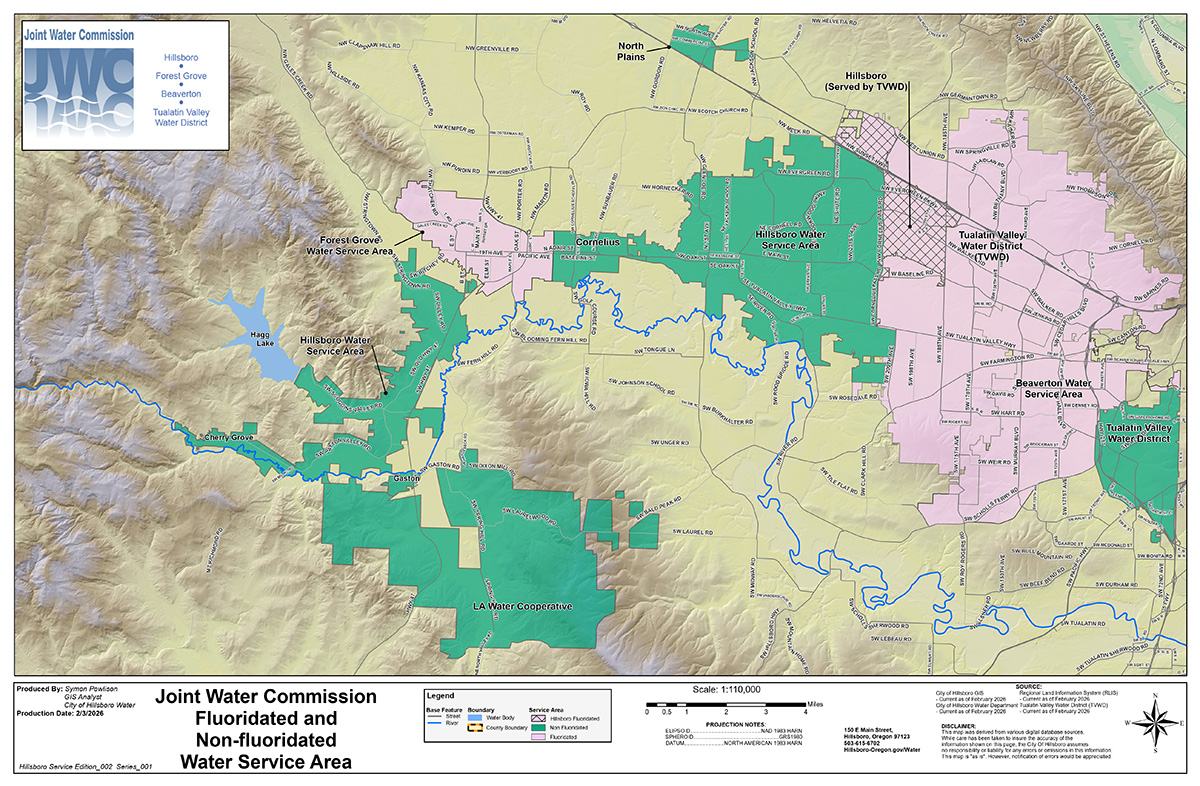
Map of Fluoridated JWC Service Areas
The map below shows which Joint Water Commission (JWC) service areas are fluoridated and which are not. Fluoridated areas are not solely defined by city boundaries, so please use the map and zooming tool to see if your water provider fluoridates the water in your neighborhood. If you have further questions regarding fluoridation and the JWC, please contact either the JWC or your local water provider for more information.

Water tap closeup
Steps You Can Take in the Home to Reduce Exposure to Lead in Drinking Water:
- Flush pipes for 30 seconds to two minutes before using water for drinking or cooking, especially if water hasn't been used for several hours or more.
- Only use cold water for eating, drinking, cooking, and making baby formula. Do not boil water to remove lead. Boiling water will concentrate lead – not remove it.
- Change out old fixtures. Plumbing regulations now stipulate that all fixtures must be manufactured lead-free. Consider installing new fixtures and/or pipes to eliminate sources of exposure.
- Test water. The only way to know if lead is present in your household water is to have it tested by an Oregon Health Authority (OHA) accredited laboratory.
- Other sources of household lead contamination, such as lead-based paint, can put children at risk. Contact the Washington County Health Department for additional resources on lead reduction.
- Do not boil water to remove lead. Boiling water will concentrate lead – not remove it.
- Additional information on minimizing lead exposure is available from the Safe Drinking Water Hotline: 503-988-4000, the Environmental Protection Agency Website, or the Center for Disease Control Website.
For more information on lead specific to your service area, please contact your water agency:

Reducing Risk of PFAS in Drinking Water
PFAS, short for perfluoroalkyl and polyfluoroalkyl substances, are chemical compounds manufactured and used for decades to repel water, grease, and oil.
They can be found in many common products, including fire-fighting foam, carpets, clothing, nonstick cookware, food packaging, plastic coating, dental floss, and some high-end ski waxes.
How Can PFAS Get into the Water Supply?
Because PFAS are so widely used, the chemicals can get into the water cycle in several ways.
Firefighting foam can seep into groundwater supplies. PFAS-containing products in landfills can break down and the chemicals can leach out of the landfill. When PFAS-containing products are washed with water, trace amounts of the chemicals can be carried down the drain and into the community’s wastewater system.
How are PFAS in Drinking Water Regulated?
PFAS don’t easily break down earning themselves the nickname the “forever chemicals.” Research by the Centers for Disease Control and Prevention show most people in the United States have been exposed to some PFAS. Research suggests exposure to high levels of certain PFAS may lead to health impacts.
In 2016, the United States Environmental Protection Agency (U.S. EPA) issued a health advisory asking drinking water providers to test for two specific kinds of PFAS (PFOA and PFOS) and look for anything over 70 parts per trillion. In June 2022, EPA issued a new, interim health advisory on those two kinds of PFAS in drinking water with significantly lower limits (far lower than that 70 parts per trillion in the 2016 advisory). Learn more about EPA health advisories.
On March 14, 2023, the U.S. EPA proposed the first-ever national standard to limit PFAS in drinking water. The comment period for this proposed rule has ended and a final determination is expected in late 2023. Learn more here.
What is the JWC Doing about PFAS?
The JWC is committed to ensuring a clean, high-quality water supply for our partners and wholesale customers. We are dedicated to work with legislators, state and local regulators, and other drinking water utilities on how to best find, control, remove, and prevent PFAS contamination in water.
Staff are actively following the U.S. EPA’s regulatory process and continually evaluating technologies and treatment options to address PFAS in drinking water.
Through the UCMR 3 process spanning 2013 and 2015, the JWC partners tested for PFAS-related compounds in their drinking water and did not detect PFAS above the reportable limit set by the method approved by the U.S. EPA.
How can the community reduce risk of PFAS?
Below are tips to reduce risk of PFAS.
- Install In-Home Water Treatment: In-home water treatment filters containing activated carbon or reverse osmosis membranes have been shown to be effective at lowering the levels of PFAS in water. Learn about certified in-home water treatment filters.
- Contaminated Fish: Avoid eating fish from waterways impacted by PFAS. You can determine which waterways are of concern by contacting your state or tribal fish advisory programs using the U.S. EPA’s list of state, territory, and tribal fish advisory contacts.
- Use PFAS-Free Consumer Goods: Consider using PFAS-free products* to protect your health and reduce the amount of PFAS in circulation.
Find additional tips to reduce exposure to PFAS in drinking water on the U.S. EPA’s website.
* The product information on this website does not constitute endorsement or recommendation by the JWC. It is your responsibility to verify and investigate any products you choose to purchase.
As part of the United States Environmental Protection Agency’s (U.S. EPA) Unregulated Contaminant Monitoring Rule 5 (UCMR5), the Joint Water Commission (JWC)’s four partners – including the Cities of Hillsboro, Forest Grove, Beaverton, and the Tualatin Valley Water District – will be collecting and testing water samples for 30 unregulated contaminants between 2023 and 2025.
Find your water provider for additional information on water quality monitoring.
Contaminants include 29 Per- and polyfluoroalkyl substances (PFAS) and Lithium. Testing will begin in July 2023.
JWC Partner Test Results
Access UCMR 5 unregulated contaminant test results from the JWC partner’s links below OR contact each partner for individual results:
- City of Hillsboro, 503-615-6700, Email, 150 East Main Street, Third Floor, Hillsboro, Oregon 97123
- City of Forest Grove, 503-992-3259, Email, 1924 Council Street, Forest Grove, Oregon 97116
- City of Beaverton, 503-526-2222, Email, 12725 SW Millikan Way, Beaverton, Oregon 97005
- Tualatin Valley Water District, 503-649-2733, Email, 1850 SW 170th Avenue, Beaverton, Oregon 97003
Unregulated Contaminant Monitoring
Background
As part of the Unregulated Contaminant Monitoring Rule (UCMR) program, the U.S. EPA identifies a list of unregulated contaminants to be monitored by public water systems once every five years.
Unregulated contaminants are those that may be present in drinking water but are not yet subject to U.S. EPA drinking water standards.
Information about unregulated contaminants collected during the UCMR testing process is then used to support the U.S. EPA’s regulatory determinations.
So far, four UCMR cycles have been completed.
| UCMR Cycle | Timeframe | Number of Unregulated Contaminants to Monitor for the U.S. EPA |
| 1 | 2001 to 2003 | 26 |
| 2 | 2008 to 2010 | 25 |
| 3 | 2013 to 2015 | 30 |
| 4 | 2018 to 2020 | 30 |
UCMR 5
During the UCMR 5 cycle – which spans from 2023 to 2025 – public water systems are collecting information on 30 different unregulated contaminants for the U.S. EPA, which includes 29 Per- and polyfluoroalkyl substances (PFAS) and Lithium.
- PFAS: A group of synthetic chemicals used in a wide range of consumer products and industrial applications including non-stick cookware, water-repellent clothing, stain-resistant fabrics and carpets, cosmetics, firefighting foams, electroplating, and products that resist grease, water, and oil.
- Lithium: A naturally occurring metal that may concentrate in brine waters; lithium salts are used as pharmaceuticals, used in electrochemical cells, batteries, and in organic syntheses.
Sampling Locations
The JWC partners will collect water samples at the entry points – or the location at which water enters their respective distribution systems – then test the samples for the 30 UCMR 5 unregulated contaminants.
Sampling Frequency
During UCMR 5, JWC partners will collect water samples four times during a consecutive 12-month monitoring period, as decided by the U.S. EPA.
Test Results
JWC partner’s test results for UCMR 5 unregulated contaminants will be reported to the U.S. EPA to be included in the National Contaminant Occurrence Database for drinking water and can be accessed by contacting each partner for individual results.
Detections
If a JWC partner detects an UCMR 5 unregulated contaminant below, at, or above the U.S. EPA’s Minimum Reporting Level (MRL) or Oregon Health Authority’s Health Advisory Level (HAL), the JWC will take the below actions as outlined in the Safe Drinking Water Act.
| Detection Level | Action by the JWC |
| No detection | No action required. |
Detection
|
No action required. |
Detection
|
Evaluate options to adjust drinking water treatment process to remove contaminants. |
Detection
|
Evaluate options to adjust drinking water treatment process to remove contaminants. |
Any detections by the partners will also be reported in their respective annual Drinking Water Quality Reports.
Note: The MRL is the smallest concentration of a substance that can be reliably measured. The Oregon HAL is level that the State has determined as the minimum amount of a substance that can cause health effects. Access additional information on Oregon HALs for PFAS.
Good Water Makes Good Beer – and Good Water comes from the JWC!
Joint Water Commission operators and water quality staff regularly test and analyze the characteristics of our water both before and after treatment. This information is used to adjust treatment techniques to ensure customers receive water that is safe to drink. Some customers, including homebrewers, may be interested in detailed information about the mineral content and chemistry of their water.
Depending on the process you use (all-grain brewing vs. malt extract brewing), water characteristics can make a difference in how the final product tastes. Minerals in the water can affect the starch-to-sugar conversion of the mash and change the beer’s taste. The all-grain brewing process is most significantly impacted by water chemistry. In malt extract brewing, the starches have already been converted into sugars (in the malt extract), so the effects of water minerals on the flavor of the beer are greatly reduced.
If you are using the all-grain brewing process, the following information could be important to the resulting flavor of your beer.
pH and Hardness
Water leaving the JWC Water Treatment Plant has a target pH of 7.8, and has a hardness measurement of approximately 2 grains per gallon, or 34 ppm. Recent data on pH and Hardness is available by clicking here.
Minerals, Influences, and Ideal Brewing Ranges
| Mineral | Influence | Ideal Brewing Range |
| Calcium (Ca+2) | Promotes clarity, flavor & stability in finished beer; needed to assure sufficient enzyme activity in mashes | 50 - 150 ppm |
| Chloride (Cl-1) | Accentuates the flavor and fullness of beer, but can cause a "medicine-like" flavor if concentration is too heavy. | 0 - 250 ppm |
| Magnesium (Mg+2) | An important yeast nutrient in small amounts, but too much can give beer a sour/bitter taste. | 10 - 20 ppm |
| Sodium (Na+1) | Just like in food, the right amount of sodium rounds out a beer's flavor & accentuates the sweetness of the malt. Too much and the beer will taste salty. Sodium & sulfate can also combine to create a harsh bitterness, so avoid high concentrations of both minerals together. | 0 - 150 ppm |
| Sulfate (SO4-2) | Accentuates hop bitterness, makes it seem drier and crisper. However, at high concentrations the bitterness can become astringent and unpleasant. | 50 - 150 ppm(normal bitter) 150 - 350 ppm (very bitter) |
| pH | Water pH influences pH of the mash. Mash pH is important to the brewing process. | Mash pH: 5.1 - 5.5 |
Other Water Quality Information
The Joint Water Commission performs a detailed water analysis of its treated water twice a year. If there are other minerals or aspects of JWC water that you would like to consider as part of your home-brewing process, complete water analyses reports are available here.
The majority of these recorded events are based on parameters set for Industrial Users. Small changes in water quality that have no impacts on the safety of drinking water can affect industrial processes. Substances in the drinking water, such as Total Organic Carbons (TOCs), are not a health concern, but they can interfere in the production of electronic components. For questions about any of the events reported below, please call 503-615-6700.
| Date of Event | Event Description | Water Quality Impacts |
| 3/31/25 – 5/9/25 | Partial Wapato Lake dewatering | The US Fish and Wildlife Service began partially dewatering Wapato Lake in accordance with their restoration goals. Pumping lasted approximately 39 days. This pumping can affect water quality entering the JWC water treatment plant and may result in treatment changes to maintain finished water quality. |
| 3/22/2025 | TOC levels above 1.0 ppm due to recent weather event. | There are no health impacts associated with these changes and the water remains safe to drink. This notice is for industrial purposes only. |
| 3/1/2025 | Treatment Change: Caustic Soda no longer being added to Rapid Mix due to improvements in raw water chemistry. | The addition of caustic soda occurs early in the treatment process and is not likely to have a negative effect on finished water quality. However, any change to the treatment process has the potential to impact industrial processes. No health impacts. |
| 2/26/25 | TOC levels above 1.0 ppm due to recent weather event. | There are no health impacts associated with these changes and the water remains safe to drink. This notice is for industrial purposes only. |
| 2/23/25 | Treatment Change: Caustic Soda added to Rapid Mix, due to changes in raw water chemistry. | The addition of caustic soda occurs early in the treatment process and is not likely to have a negative effect on finished water quality. However, any change to the treatment process has the potential to impact industrial processes. No health impacts. |